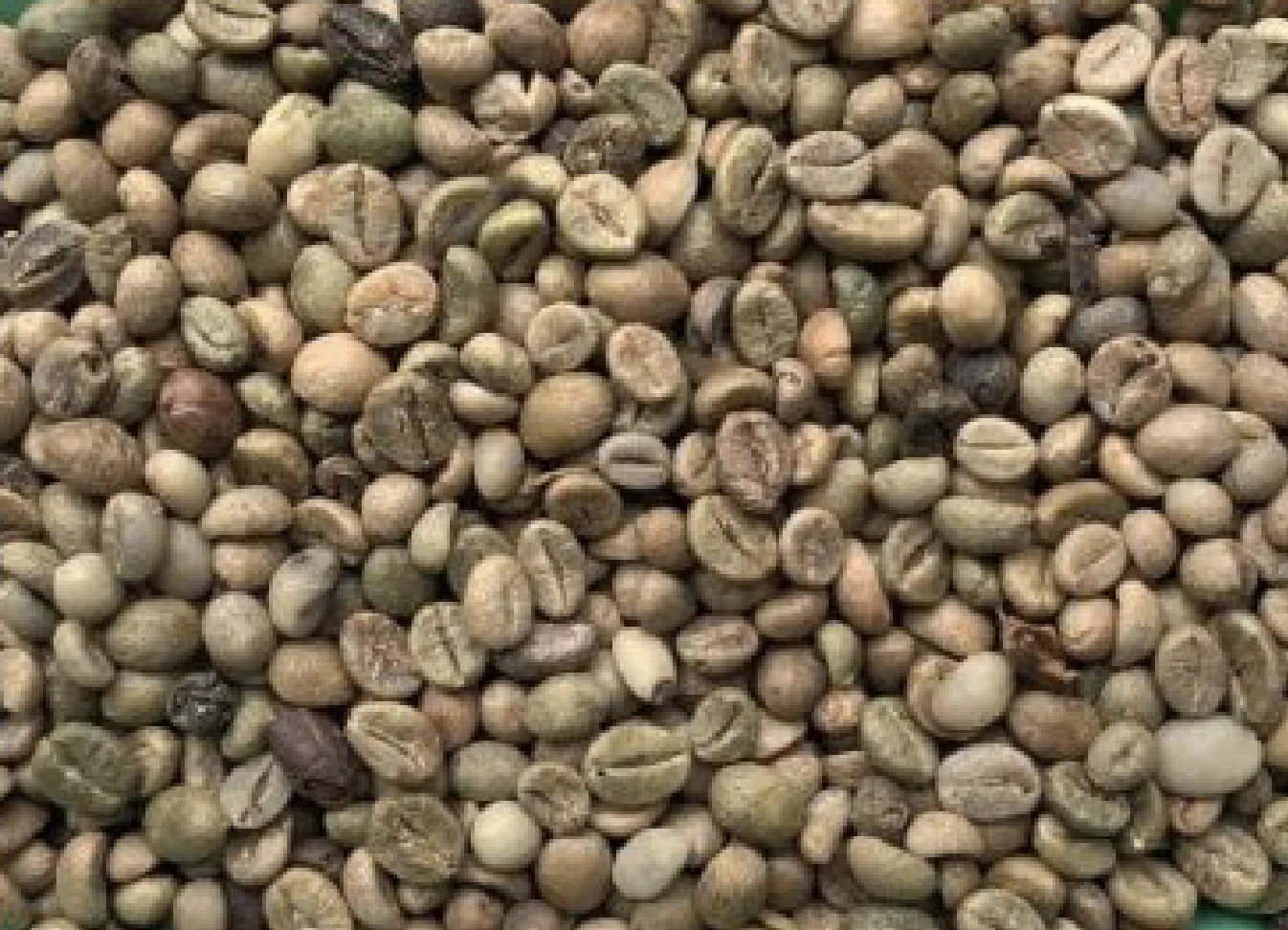
Container condensation, known as "Container Rain," is the leading cause of catastrophic cargo loss in the global coffee trade. It occurs when a container loaded in the humid tropics of Vietnam transits into colder climates, causing the internal moisture vapor to hit its dew point and condense into liquid water on the steel ceiling. This water drips back onto the coffee, creating localized zones of 100% humidity that spawn devastating mold within 72 hours. Prevention requires drying coffee to strict 12.5% limits, using heavy Kraft paper lining, and deploying massive calcium chloride desiccants.
The Thermodynamics of the Steel Box
A 20ft shipping container is a highly volatile micro-climate. When 19.2 tonnes ofVietnamese green coffeeis loaded into it, the beans are alive—they are respiring and exchanging moisture with the air. The air trapped inside the container inHo Chi Minh Cityholds a massive amount of water vapor. As the vessel sails toward Rotterdam in the middle of winter, the steel walls cool rapidly. Cold air cannot hold as much moisture as hot air. Once the temperature drops below the dew point, the invisible vapor turns into physical water droplets. This is container rain.
The Three-Tier Defense Strategy
If container rain drips onto jute bags ofFine Robusta, the beans will swell, turn white withPenicilliummold, and develop musty/phenolic defects that destroy the cup score. Elite exporters fight this using a three-tier system: 1)Source Control:Ensuring themoisture contentof the bean is strictly below 12.5%. 2)Insulation:Taping thick corrugated Kraft paper to the entire interior of the container to act as a thermal break and moisture sponge. 3)Aggressive Desiccation:Hanging 1.5kg to 2.0kg Absorgel poles from the ceiling hooks. These poles chemically absorb water vapor, turning it into a gel, physically pulling the humidity out of the air before it can ever condense.
The Ultimate B2B Masterclass: Coffee Economics & Risk Arbitrage
The global coffee trade is a multi-billion dollar casino, disguised as an agricultural supply chain. You are not just buying beans; you are trading foreign exchange, hedging weather patterns, navigating geopolitical blockades, and betting against algorithmic commodity funds. A single frost in Brazil or a container shortage in the Red Sea can wipe out your annual profit margin overnight. To survive and dominate as a modern B2B coffee buyer, you must elevate your understanding from mere "roasting profiles" to advanced macro-economic risk arbitrage. This is your definitive, uncompromising masterclass on the financial physics of global coffee.
1. Macro-Economics: The Global Supply/Demand Nexus
Coffee prices are dictated by brutal laws of supply and demand, heavily skewed by the massive output of two nations: Brazil (the Arabica giant) and Vietnam (the Robusta titan). When you buy Vietnamese Robusta, you must monitor global macro-indicators. Is the world entering a recession? If so, consumers downgrade from expensive specialty Arabica to cheaper, highly caffeinated Robusta blends to save money. This causes Robusta demand (and consequently, its ICE futures price) to skyrocket. Conversely, if shipping lanes from Asia are disrupted, European buyers will panic-buy local spot inventory, driving up premiums. Understanding these macro shifts allows you to lock in long-term forward contracts before the market violently corrects.
2. The Devastation of El Niño and La Niña
You cannot trade coffee without trading the weather. The ENSO cycle (El Niño-Southern Oscillation) is the ultimate market maker. A strongEl Niñotypically brings devastating drought to Southeast Asia, drastically reducing the yield of the Vietnamese Robusta harvest in Buon Ma Thuot. This drought forces the coffee cherries to abort, leading to a massive global shortage and subsequent price explosions on the London terminal market. Conversely,La Niñaoften brings excessive, torrential rains to Vietnam during the critical harvesting and drying months (November-December). If the farmers cannot sun-dry the coffee, and mechanical dryers are overwhelmed, the quality plummets, resulting in massive defect counts and a severe shortage of premium Grade 1 coffee. A professional buyer tracks Pacific Ocean surface temperatures as closely as they track their bank accounts.
3. Financial Arbitrage: The Inter-Month Spread
In commodity trading, physical inventory is both an asset and a liability. The relationship between the price of coffee today (the nearby futures contract) and the price of coffee six months from now (the deferred contract) is the "Spread."
- Contango:This is a normal market where future prices are higher than current prices. The higher price compensates traders for the cost of storing and insuring the physical coffee in a warehouse (Cost of Carry). If the market is in contango, roasters are incentivized to buy coffee Just-In-Time (JIT), letting the supplier bear the storage costs.
- Backwardation:This is a panic market. Prices today are massively higher than future prices because there is an immediate, desperate shortage of physical coffee. When a market flips into steep backwardation, professional buyers stop buying forward contracts and immediately secure physical FOB shipments, regardless of the spot premium, because the market is signaling that the physical supply chain is breaking down.
4. The Architecture of Risk Management (Hedging)
If you are a large-scale commercial roaster or an instant coffee manufacturer, you cannot allow your raw material costs to fluctuate by 40% year-over-year. You must hedge. The most sophisticated buyers do not simply execute a basic Long Hedge; they utilize Options contracts (Calls and Puts) on the ICE futures exchange. By purchasing Call Options, a roaster buys the "right, but not the obligation" to purchase coffee at a specific price. This acts as an insurance policy against massive price spikes, while still allowing the roaster to benefit if the global coffee price collapses. Structuring these derivative plays requires deep capital reserves and elite brokerage access, but it completely immunizes the roasting operation from global market shocks.
5. Advanced Quality Control: The Defect Matrix
When buying unseen containers from halfway across the world, trust is built entirely on the mathematical rigor of the Defect Matrix. Both the Green Coffee Association (GCA) and the Coffee Quality Institute (CQI) utilize strict numerical systems. A single "Full Black Bean" (caused by severe fermentation or disease on the tree) counts as one full defect. "Severe Insect Damage" counts as one defect. A "Partial Sour Bean" might count as 1/3 of a defect. If you purchase a contract for Vietnamese Grade 2 Screen 16, the contract explicitly states "Maximum 5% Black and Broken beans." When the container arrives, an independent surveyor pulls samples and conducts a physical count. If the defect count registers at 6%, you have the legal right to reject the container, demand a severe price discount (an allowance), or force the exporter to replace the shipment or face arbitration in London.
6. Foreign Exchange (Forex) Velocity
The entire global coffee trade is denominated in US Dollars (USD). Therefore, if you are a roaster in Tokyo (using JPY), London (using GBP), or Frankfurt (using EUR), you are simultaneously trading two commodities: Coffee and Dollars. If the US Federal Reserve raises interest rates, the USD strengthens. This means that even if the physical price of coffee remains perfectly flat, the cost of that coffee in your local currency will surge dramatically. Advanced B2B buyers must execute forward currency hedges simultaneously with their coffee futures hedges to lock in their total landed cost. A failure to hedge Forex risk has bankrupted countless mid-sized roasters.
7. Frequently Asked Questions (FAQ) on Global Coffee Trading
Let’s resolve the most complex, high-intent technical questions regarding the financial and logistical architecture of the global coffee trade.
What is the difference between the London (Robusta) and New York (Arabica) Coffee Exchanges?
The Intercontinental Exchange (ICE) operates two distinct terminal markets. ICE Futures U.S. (New York) trades the "C Contract" (Ticker: KC), which is the global benchmark for Washed Arabica coffee, priced in US Cents per pound. ICE Futures Europe (London) trades the Robusta contract (Ticker: RC), which is the benchmark for all Robusta, including Vietnamese origins, priced in US Dollars per metric tonne. They operate independently, and the price difference between them is known as the "Arbitrage."
How does the "Differential" work in an FOB Coffee Contract?
Physical coffee is rarely sold at the exact exchange price. The "Differential" is the premium or discount applied to the physical beans based on their quality and availability. For example, highly sought-after Vietnamese Grade 1 Wet-Polished Robusta might trade at "+$150" over the London price. Standard commercial Grade 2 might trade at "Par" (zero difference) or even "-$50" (a discount) depending on current local supply dynamics in Buon Ma Thuot.
What happens if a vessel declares "General Average"?
General Average is an ancient maritime law principle. If a ship faces a catastrophic emergency (e.g., catching fire or running aground in the Suez Canal) and the captain must intentionally jettison cargo or incur massive salvage costs to save the ship, ALL cargo owners on the ship must proportionally share the financial loss. Even if your coffee container is perfectly safe on the deck, you must pay your share of the salvage bill before the shipping line will release your cargo. This is the primary reason why Institute Cargo Clauses (A) insurance is absolutely mandatory.
How does the "Fixation" process work for buyers?
When a buyer signs a contract with a differential (e.g., London + $100), the final price is not set yet. The buyer has the right to "Fix" the price at any point before a specified deadline (usually a few weeks before shipment). The buyer watches the live London ICE ticker. When the market dips to a favorable level, the buyer calls the exporter or their broker and says, "Fix it now." The price is instantly locked based on that exact second's trading value, and the final commercial invoice is generated.
Why do buyers demand "Shipment Samples" before the container leaves?
Before authorizing the final loading of the container, buyers will require the exporter to send a 500g "Pre-Shipment Sample" via DHL. The buyer roasts and cups this sample. If the sample matches the agreed-upon quality profile, the buyer issues an "Approval," authorizing the exporter to execute the Bill of Lading. If the coffee arrives 40 days later and tastes completely different from the approved sample, the buyer has legal grounds to claim the exporter swapped the coffee or that it was ruined in transit, triggering an insurance claim or arbitration.
8. The Science of the Yield Curve and Financing
In B2B coffee trading, capital is often just as expensive as the coffee itself. When interest rates are high, the cost of financing a multi-million dollar shipment of coffee skyrockets. Traders must understand the yield curve. If short-term interest rates exceed long-term rates (an inverted yield curve), it becomes punishingly expensive to hold physical inventory in a warehouse. This forces massive multi-national roasters to liquidate their spot inventory and aggressively shift to "Just-In-Time" (JIT) supply chains, relying entirely on Vietnamese exporters to hold the coffee in Buon Ma Thuot until the very last second. Exporters who possess the capital depth to offer Vendor Managed Inventory (VMI) or extended payment terms during high-interest-rate environments instantly capture massive market share from weaker competitors.
9. Geopolitical Flashpoints and Logistics Blockades
The global supply chain is agonizingly fragile. A single geopolitical flashpoint can instantly sever the coffee artery between Vietnam and Europe. Consider the Red Sea crisis. If vessels cannot safely transit the Suez Canal, they must divert around the Cape of Good Hope in South Africa. This diversion adds 14 to 21 days to the transit time. Not only does this massively increase the cost of ocean freight and bunker fuel surcharges, but it also creates a catastrophic thermodynamic risk. Coffee that was prepared for a 30-day voyage is suddenly trapped inside a steel container for 50 days, exponentially increasing the risk of "container rain" and mold. A professional B2B buyer must constantly monitor global geopolitical maritime security and adapt their insurance (e.g., adding War Risk riders) and packaging (mandating GrainPro for all diverted shipments) in real-time.
10. The Algorithmic Dominance of Hedge Funds
You are not just negotiating against other roasters; you are trading against supercomputers. In the modern era, the ICE Futures Europe exchange is dominated by Non-Commercial traders (hedge funds and algorithmic trading firms). These funds do not roast coffee; they trade momentum. If a weather model predicts a 20% chance of frost in Brazil, their algorithms will instantly execute massive "Long" positions, driving the price of all coffee (including Vietnamese Robusta) to astronomical highs within milliseconds. Conversely, if technical indicators show a "Death Cross" on the moving averages, the algorithms will heavily short the market, causing prices to crash. Understanding the Commitment of Traders (COT) report—which shows exactly how many contracts these funds are holding—is absolutely essential for a B2B buyer attempting to time their contract fixation.
11. Certification Arbitrage (EUDR, 4C, Rainforest Alliance)
Certifications are no longer just marketing tools; they are legal weapons and economic moats. The European Union Deforestation Regulation (EUDR) has fundamentally bifurcated the global market. Coffee that possesses flawless GPS polygon tracing and 4C (Common Code for the Coffee Community) certification can freely enter Europe and commands a massive premium. Coffee that lacks this data is completely locked out of the EU and must be sold at a severe discount to less regulated markets like China or the Middle East. This creates a "Certification Arbitrage." Buyers who invest heavily in digitizing the supply chain in Buon Ma Thuot can secure EU-compliant coffee at the source, while unprepared competitors are forced to scramble in the spot market, paying exorbitant premiums to brokers in Rotterdam.
12. The Power of Direct Trade vs Trade Houses
Historically, the coffee trade was controlled by a handful of massive, opaque multinational trading houses (the "ABCDs" of agriculture). Today, the internet and blockchain have democratized logistics. Progressive European and American roasters are bypassing the massive Swiss and Dutch intermediaries and executing FOB contracts directly with elite export consortiums in Buon Ma Thuot. This "Direct Trade" model eliminates the middleman's markup (often 5% to 10% of the container value). Furthermore, it provides the roaster with unprecedented traceability, allowing them to directly fund sustainability projects in the Central Highlands. However, Direct Trade requires the roaster to fully master the incoterms, L/C mechanics, and customs brokerage that the trading houses previously handled for them.
13. Demurrage, Detention, and the Financial Penalties of Port Congestion
In global logistics, time is literally money. The shipping line provides a narrow window of "Free Time" (usually 3 to 5 days) for the buyer to clear customs and physically remove the container from the destination port. If the container sits at the port beyond this window, the port authority begins chargingDemurrage. These fees are punitive, often starting at $150 per day and escalating rapidly to over $400 per day. If a customs broker makes an error on the Bill of Lading, or if the Phytosanitary Certificate is missing, a container of coffee can be locked in port for three weeks, accumulating $10,000 in demurrage fees, instantly erasing the buyer's entire profit margin on the trade.
Furthermore, once the container is removed from the port, the buyer must unload the coffee and return the empty steel container to the shipping line's depot. If the buyer takes too long to return the empty box (perhaps because their roasting warehouse is full or they cannot secure a truck chassis), the shipping line chargesDetentionfees. A master logistician negotiates extended Free Time (e.g., 14 days or 21 days) directly into the FOB freight contract BEFORE the coffee ever leaves Vietnam, providing a massive financial buffer against unpredictable port congestion.
14. The Anatomy of a Letter of Credit (L/C) Discrepancy
As previously established, L/C trading operates under the Doctrine of Strict Compliance. A "Discrepancy" occurs when the documents presented by the Vietnamese exporter do not perfectly match the terms outlined in the L/C. While major discrepancies (like a missing Certificate of Origin) are catastrophic, it is the minor, hyper-technical discrepancies that routinely derail multi-million dollar trades.
Consider this scenario: The L/C states the cargo is "Vietnamese Robusta Coffee Grade 1 Screen 18." However, the Commercial Invoice generated by the exporter states "Vietnamese Robusta Grade 1 Sc 18." The bank will instantly reject the presentation because "Sc" is not the exact word "Screen." The bank will charge a Discrepancy Fee (often $100 to $250) and refuse to release the funds. The exporter must now rapidly contact the buyer, asking the buyer to explicitly instruct their bank to "Waive the Discrepancy." During this tense negotiation, the ship carrying the coffee might arrive at the destination port. If the documents are held up at the bank due to a typo, the buyer cannot claim the container, immediately triggering the catastrophic Demurrage fees discussed above. This is why elite exporters employ dedicated, highly trained documentation specialists whose sole job is to proofread every character on every document against the L/C.
15. Master Your Supply Chain Economics
We are not just farmers; we are quantitative logisticians. Our B2B export desk in Buon Ma Thuot operates at the bleeding edge of the global commodity trade. We understand the math behind the moisture. We execute flawlessly under the strictest Letters of Credit. We provide the immutable blockchain tracing required by the EUDR. And we offer the massive volume consistency that multi-national roasting conglomerates demand to execute their global hedging strategies.
Ready to Dominate the Coffee Market?
Eliminate the middlemen. Eradicate supply chain volatility. Partner with an exporter who understands the financial velocity of the B2B market. Contact our trade desk today to negotiate forward contracts, discuss ICE differentials, and secure your long-term supply of premium Vietnamese Robusta.