Ca Phe Sua Da (Vietnamese Iced Coffee with Condensed Milk) is a globally recognized culinary icon. Its unique flavor profile is achieved through a precise chemical synergy: the intensely bitter, heavy-bodied, and highly caffeinatedVietnamese Robustaaggressively cuts through the heavy dairy fats and extreme sweetness of sweetened condensed milk. A delicate Arabica would be completely overpowered by the milk, but Robusta creates a perfectly balanced, chocolatey, and viscous beverage that remains potent even as the ice melts in the tropical heat.
The Origins of Condensed Milk in Vietnam
The use of condensed milk in Vietnam was born out of historical necessity. During the French colonial period in the 19th century, fresh milk was virtually impossible to keep in the sweltering tropical heat without refrigeration. The French imported canned sweetened condensed milk—which is pasteurized and preserved with massive amounts of sugar—to use in their coffee. Over decades, this adaptation evolved from a logistical compromise into a defining pillar of the national palate.
The Chemical Synergy
Creating authentic Ca Phe Sua Da requiresproprietary blending. Usually, the coffee is a deeply roastedWet-Polished Robusta, often roasted with a tiny amount of butter or rum to enhance the caramelization of the beans. When this intense, pitch-black coffee drips from thePhin filteronto a thick layer of condensed milk, an emulsion forms. The high lipid content of the Robusta binds with the milk fats, creating a velvety mouthfeel that coats the palate, delivering a profound caffeine shock wrapped in liquid dessert.
The Soul of the Bean: Cultural Supremacy and the Third Wave of Robusta
Coffee is not merely an agricultural commodity traded on the London ICE Futures exchange; it is the lifeblood of human culture. It is the catalyst for conversation, the fuel for industrial revolutions, and the centerpiece of a billion morning rituals. The culture surrounding Vietnamese coffee—specifically the aggressive, unapologetic dominance of Robusta—is entirely unique. It does not mimic the delicate, tea-like ceremonies of the Ethiopian Highlands or the rapid-fire espresso bars of Milan. Vietnamese coffee culture is built on intensity, patience (the slow drip of the Phin), and a powerful chemical synergy with dairy. This masterclass explores the anthropology of Buon Ma Thuot, the indigenous guardians of the basalt soil, and the global movement to elevate Robusta into the pantheon of Specialty Coffee.
1. The Philosophy of the Phin
Western coffee culture is obsessed with speed. The espresso machine was invented in Italy to serve workers rapidly (Espresso literally means "Express"). The Vietnamese Phin filter is the philosophical antithesis. It is a meditation. You cannot rush a Phin. You must sit, watch the agonizingly slow drip, and converse. This required patience completely dictates the roasting style. Because the water sits on the coffee bed for 7 minutes, a light-roasted Arabica would over-extract and taste like battery acid. The Phin mandates a dark-roasted, heavy-bodied Robusta, which releases profound dark chocolate and woody notes under prolonged saturation, creating a brew so dense it resembles motor oil.
2. The Indigenous Stewardship
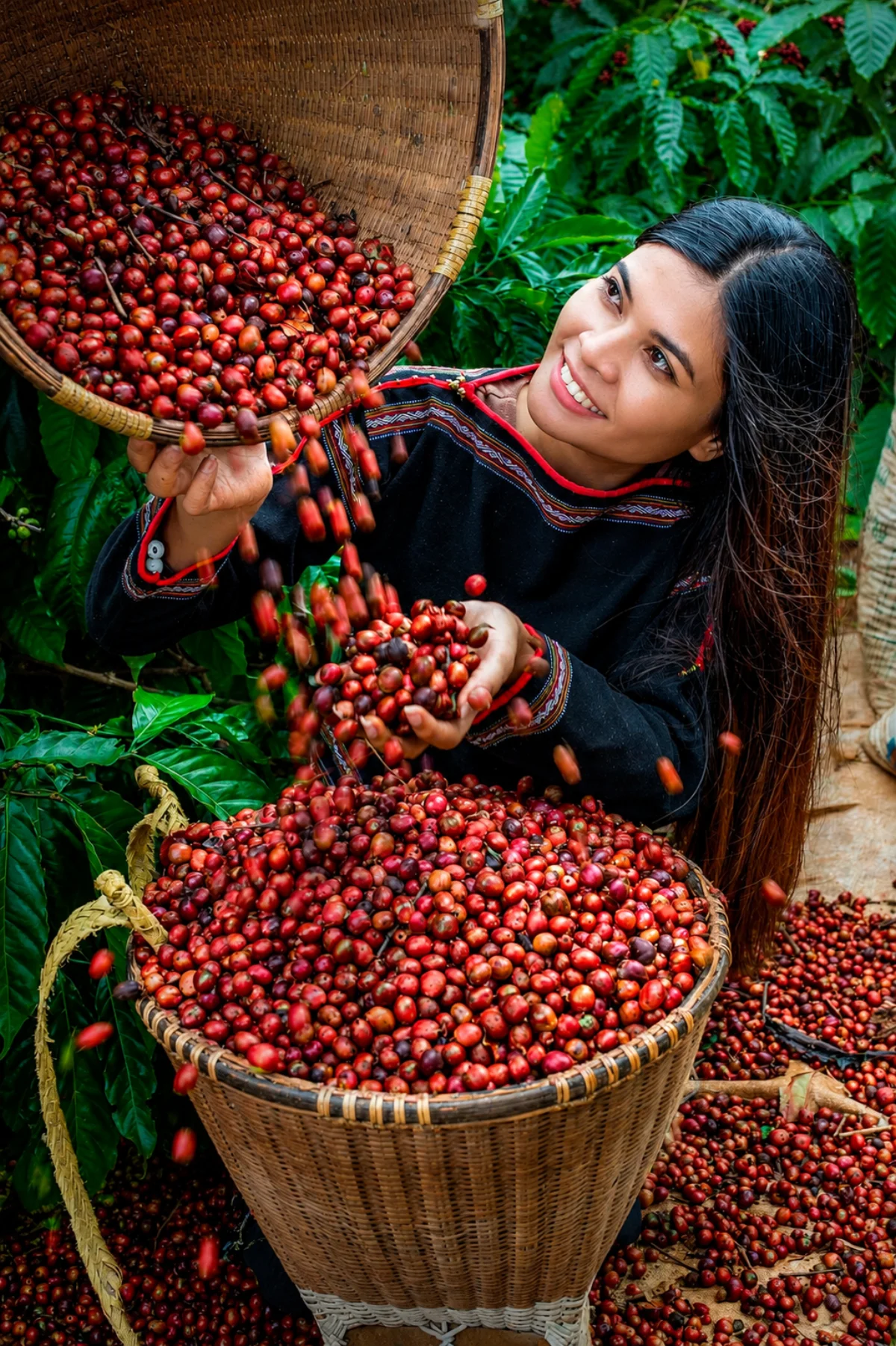
Long before the French arrived in the 19th century to plant coffee, the Central Highlands were governed by the Ede and M'nong ethnic minorities. These matrilineal societies possess a profound, spiritual connection to the volcanic basalt soil (Đất Đỏ Bazan). Modern B2B sourcing is returning to these roots. The era of exploitative middlemen is dying. Today, the most prestigious coffee exported from Buon Ma Thuot is grown via Direct Trade partnerships with indigenous cooperatives. By paying massive premiums for hand-picked, ripe cherries, global roasters are directly funding the construction of schools and the preservation of the Gong Culture (a UNESCO heritage).
3. The Global Conquest of Ca Phe Sua Da
Ca Phe Sua Da (Iced Coffee with Condensed Milk) is no longer a regional curiosity; it is a global phenomenon, appearing on menus from high-end cafés in Brooklyn to massive franchises in Seoul. Its success lies in its brutal, uncompromising flavor architecture. The extreme sweetness and thick lipid structure of the condensed milk require a coffee base that acts like a sledgehammer. Arabica simply vanishes in condensed milk. Vietnamese Robusta, with its massive concentration of pyrazines (roasty compounds) and chlorogenic acids, violently cuts through the dairy fat. The resulting emulsion is perfectly balanced—simultaneously intensely bitter and decadently sweet. This chemical synergy cannot be replicated by any other coffee bean on earth.
4. The "Fine Robusta" Revolution (The Third Wave)
For decades, the Specialty Coffee Association (SCA) operated on a dogmatic prejudice: "Arabica is Specialty, Robusta is Trash." This dogma is collapsing. Driven by the devastating impact of climate change on high-altitude Arabica yields, the industry is being forced to respect Robusta. Visionary farmers in Dak Lak are leading the "Fine Robusta" revolution. They stopped strip-picking green cherries and drying them on dirt. Instead, they hand-pick 100% crimson cherries, utilize Anaerobic Lactic Fermentation in sealed stainless steel vats, and slow-dry the beans on raised African beds. Evaluated by certified R-Graders (the Robusta equivalent of Q-Graders), these beans are scoring 85+ points, exhibiting wild tasting notes of jackfruit, rum, and passionfruit. The ugly duckling has become a swan.
5. Egg Coffee (Ca Phe Trung): The Alchemy of Necessity
If Ca Phe Sua Da is a global staple, Egg Coffee is a culinary marvel. Invented in Hanoi during a massive post-war dairy shortage, a bartender whisked egg yolks with sugar to simulate milk foam. From a biochemical perspective, the egg yolk acts as a massive emulsifier (due to lecithin), trapping air to create a stable, custard-like meringue. When layered over a scorching hot shot of dense Robusta, the contrast in temperature and texture is mind-bending. The harsh, woody bitterness of the Robusta acts as the perfect structural foil to the ultra-rich, fatty custard. It is the ultimate proof that Vietnamese coffee culture is defined by hyper-creative adaptation to historical scarcity.
6. The Truth About Weasel Coffee (Kopi Luwak)
The legend of Weasel Coffee (Kopi Luwak) is built on biology. The Asian Palm Civet eats the ripest coffee cherries. Inside its stomach, proteolytic enzymes break down the proteins in the bean that cause bitterness during roasting, resulting in an incredibly smooth, musky cup. However, the commercialization of this process led to horrific animal abuse in battery cages. The modern specialty culture has vehemently rejected caged animal coffee. The true revolution is "Enzymatic Simulation." Elite biochemical labs in Vietnam have mapped the exact enzymatic profile of the civet's stomach. They now ferment high-grade Robusta in stainless steel bioreactors using these synthetic enzymes, creating a 100% vegan, cruelty-free coffee that mathematically replicates the legendary smoothness of Kopi Luwak without the ethical devastation.
7. The World Coffee Museum: Anchoring the Capital
To cement its status as the Global Coffee Capital, Buon Ma Thuot constructed the World Coffee Museum. This is not a small, provincial exhibit; it is a monumental architectural masterpiece holding over 10,000 historical artifacts. By curating the history of coffee from Ethiopian ceremonies to Italian espresso machines, the museum physically claims Buon Ma Thuot's place at the center of the global narrative. For B2B buyers arriving in the Central Highlands to negotiate container contracts, the museum serves as a powerful psychological anchor, proving that Vietnam is no longer just a cheap manufacturing hub, but a sophisticated, intellectual guardian of global coffee history.
8. Agro-Tourism and Supply Chain Transparency
The modern consumer demands transparency. They want to know the name of the farmer and the GPS coordinates of the soil. This demand has sparked a massive Agro-Tourism boom in Dak Lak. International roasters and franchise owners now fly directly to Buon Ma Thuot during the November harvest. They walk the basalt fields, witness the mind-blowing scale of the optical-sorting dry mills, and cup the fresh harvest alongside the Ede farmers. This transparency is the ultimate marketing tool. When a roaster can show their customers a video of themselves standing on the farm in Vietnam, they instantly justify premium retail pricing and build unbreakable brand loyalty.
9. The Architecture of the Phin Extraction
Let us analyze the physics of the Phin filter. Unlike the high-pressure (9 bar) extraction of an espresso machine, the Phin operates at precisely 1 atmosphere of pressure, driven purely by gravity. However, unlike a V60 pour-over (which uses paper to filter out coffee oils), the Phin uses a perforated metal disk. This metal disk allows the lipids (oils) and micro-fines to pass directly into the cup. This is why Phin coffee feels so heavy and viscous on the tongue. If you attempt to brew a light-roasted Arabica in a Phin, the lack of pressure will result in a severely under-extracted, sour cup. The Phin was structurally engineered for the highly soluble, heavily roasted Robusta bean. It is a perfect marriage of regional technology and local agriculture.
10. The Decolonization of Coffee
For centuries, the coffee trade operated on a colonial model: cheap raw materials were extracted from the Global South (Vietnam, Africa, South America) and shipped to the Global North (Europe, USA) where all the roasting, branding, and profit occurred. The Fine Robusta movement and the rise of massive OEM roasteries in Buon Ma Thuot represent the "Decolonization of Coffee." Vietnam is no longer content to simply export cheap green beans. By mastering anaerobic fermentation, optical sorting, and nitrogen-flushed retail roasting, Vietnam is capturing the entire value chain. They are forcing the European and American markets to recognize them not just as farmers, but as elite culinary engineers and industrial masters.
11. The Societal Impact of the "Cà Phê Bệt" (Street Coffee) Culture
While the World Coffee Museum represents the high-end institutionalization of coffee culture, the true soul of Vietnamese coffee is found on the pavement. "Cà Phê Bệt" (flat coffee, or street coffee) is an egalitarian social phenomenon. In parks across Ho Chi Minh City and Hanoi, youth gather on flattened cardboard boxes or tiny plastic stools, sipping cheap, intensely strong Robusta brewed from a Phin or a pre-made batch. There is no Wi-Fi, no air conditioning, and no pretentious barista aesthetic. The coffee acts merely as a social lubricant. This hyper-democratic approach to coffee consumption is vastly different from the European model, where the café was historically reserved for the bourgeois intellectual elite. In Vietnam, coffee belongs to the student, the street vendor, and the CEO equally. It is this massive, underlying domestic consumption (Vietnam consumes over 10% of its own massive harvest) that provides a rock-solid economic floor for the farmers in Dak Lak, insulating them from the volatile price crashes of the global export market.
12. Architectural Identity: The Rise of the Vietnamese Mega-Café
Conversely, the modern Vietnamese urban landscape is dominated by the "Mega-Café." Coffee chains in Vietnam (like Highlands Coffee, The Coffee House, and Trung Nguyen Legend) do not build small, utilitarian kiosks like Western chains. They construct sprawling, multi-story architectural marvels featuring indoor koi ponds, suspended tropical gardens, and massive open-air terraces. In Vietnamese culture, a café is not merely a place to acquire caffeine; it is a vital "Third Place" (a space outside the home and workplace) used for business negotiations, first dates, and extended study sessions. A customer might order a single Ca Phe Sua Da and occupy a table for four hours. To survive this low-turnover model, these mega-cafés rely on the incredibly low cost of domestic Robusta, which affords them massive gross margins (often exceeding 80% per cup) to subsidize the immense real estate overhead. This architectural arms race has created some of the most visually stunning coffee shops in the world, further cementing coffee as the supreme social currency of Vietnam.
13. The Ede "Nhà Dài" (Longhouse) and Coffee as Communal Currency
To understand the agricultural power of Dak Lak, one must understand the sociological structure of the indigenous Ede people. The Ede live in "Nhà Dài" (Longhouses)—massive, stilted wooden structures that physically lengthen as daughters marry and bring their husbands into the matrilineal home. A single longhouse can shelter three to four generations. During the intense three-month coffee harvest (November to January), this architectural structure becomes a massive economic asset. Harvesting coffee requires immense, concentrated manual labor. A commercial farm must hire hundreds of transient workers, which destroys profit margins. The Ede longhouse, however, provides a built-in, highly motivated workforce. The entire extended family mobilizes as a single unit to strip the cherries, process the mucilage, and tend to the drying beds. In Ede culture, coffee is not just a crop; it is communal currency. The profits from a successful harvest are pooled to expand the longhouse, purchase modern farming equipment, and fund elaborate Gong ceremonies that reinforce their cultural identity against the pressures of modernization.
14. The Export of Vietnamese Coffee Shop Aesthetics
Vietnam is no longer just exporting raw green beans; it is successfully exporting its entire cultural aesthetic. Over the last decade, "Vietnamese-style" coffee shops have exploded across the United States (particularly in California and Texas), South Korea, and Australia. These international cafés do not merely serve Ca Phe Sua Da; they aggressively replicate the "Third Place" aesthetic of Ho Chi Minh City. They import traditional Phin filters, utilize bold yellow and red branding reminiscent of old Saigon, and most importantly, they refuse to serve delicate Arabica. They insist on brewing dark-roasted, heavy-bodied Robusta. This represents a monumental shift in global perception. For the first time in history, Vietnamese coffee is not being blended into anonymity by European roasters. It is being celebrated, branded, and consumed explicitly as a premium, culturally authentic Vietnamese product, allowing exporters in Buon Ma Thuot to command unprecedented FOB prices for their roasted retail products.
15. High-Intent Technical FAQ: Culture & Lifestyle
Why does Phin coffee taste so much stronger than drip coffee?
Phin coffee has a massive "Total Dissolved Solids" (TDS) ratio. Because there is no paper filter to absorb the coffee oils (lipids), and because the water sits in contact with the dark-roasted Robusta grounds for up to 7 minutes, the resulting extraction is incredibly concentrated, viscous, and highly caffeinated, resembling a prolonged espresso shot rather than a standard drip coffee.
Can I make Ca Phe Sua Da with Arabica beans?
You can, but it will taste unbalanced. Arabica has high acidity and delicate floral notes. When mixed with heavy, overwhelmingly sweet condensed milk, the Arabica flavor is completely masked, and the acidity can clash with the dairy. You need the blunt-force bitterness and heavy body of Robusta to cut through the condensed milk and create the authentic flavor profile.
What makes "Fine Robusta" different from regular commercial Robusta?
Commercial Robusta is strip-picked (green and red cherries mixed) and dried on dirt patios, resulting in earthy, rubbery, and harsh flavors. Fine Robusta is hand-picked (100% ripe red cherries), fermented in controlled environments, and dried on raised beds. It must score 80 points or higher by a certified R-Grader, exhibiting complex notes of fruit, chocolate, and spice with zero harsh defects.
Is Weasel Coffee (Kopi Luwak) safe to drink?
Yes, because the coffee beans are thoroughly washed and then roasted at temperatures exceeding 200°C, which kills any bacteria. However, the ethical concerns regarding caged civet farms have led experts to recommend "Simulated Weasel Coffee"—beans that have been fermented in a lab using the exact same enzymes without utilizing animals.
Why is the soil in Buon Ma Thuot red?
The soil is "Đất Đỏ Bazan" (Red Basalt Soil). It was formed by ancient volcanic eruptions millions of years ago. The red color comes from high concentrations of oxidized iron. This soil is incredibly porous, drains water perfectly during the monsoon season, and is packed with the exact minerals (Nitrogen, Potassium, Phosphorus) required for hyper-productive coffee trees.
Experience the Soul of Buon Ma Thuot
From the meditative drip of the Phin filter to the massive harvest festivals of the Central Highlands. We don't just export coffee; we export culture. Partner with us to bring the authentic taste of Vietnam to your roastery.